Ten years ago I decided I would walk the whole North Downs Way, a section at a time, whenever life let me. Life had other ideas, mostly involving other people.
Between then and now there was a house, a couple of jobs, two children growing up, and a pandemic. Ten years back a few of us had walked the Canterbury sections - east to Dover one Sunday, round to Wye and back another - and then the plan quietly stalled, the way plans do. The trail sat there the whole time, patient, getting no shorter. So this morning I finally picked it up where the gap was: Wye to Folkestone, the stretch that tips the path down to the sea.
There was a proper reason for going, beyond guilt. I’ve run this sort of distance before, years ago, grinding out the training miles for the London Marathon. But I’d never walked it, not on my own, and lately I’ve been dreaming about bigger things: proper multi-day routes, a tent or a bunkhouse, whole days in the hills with nobody to answer to. Before any of that, it seemed worth finding out whether I could actually enjoy a long day alone with only my own company. Wye to Folkestone was the test.
There was a second reason for going alone, if I’m honest. The last time Jimmy and I walked a long one together I took a wrong turn near the end and added a good three miles to a day that was already quite long enough. I don’t think he has ever entirely forgiven me. Some days you walk solo by design; some days you walk solo because your usual companions have wised up.
The forecast looked kind, so I drove over to Wye first thing, left the car, and talked Nicole into fishing me out of the far end later on.
The walk starts by going straight up. From Wye you haul yourself onto the escarpment past the Wye Crown cut white into the hillside, and out along the lip of the Devil’s Kneading Trough - a great green scoop bitten out of the downs, far more dramatic than anything in Kent has much right to be. Then it settles into the thing the North Downs Way does best: mile after mile of high, open ground with half the county poured out below on one side.
The earlier legs I’d walked were the Canterbury Loop, all Pilgrims’ Way and Via Francigena, ancient roads worn smooth by centuries of the faithful trudging to a shrine. This arm has none of that. It’s the Mainline Route, and nobody trod it to Canterbury in sandals - it’s field paths and lanes that somebody stitched into a trail when the North Downs Way was made official in 1978. I found I liked it the better for it. An honest, workmanlike path to the sea.
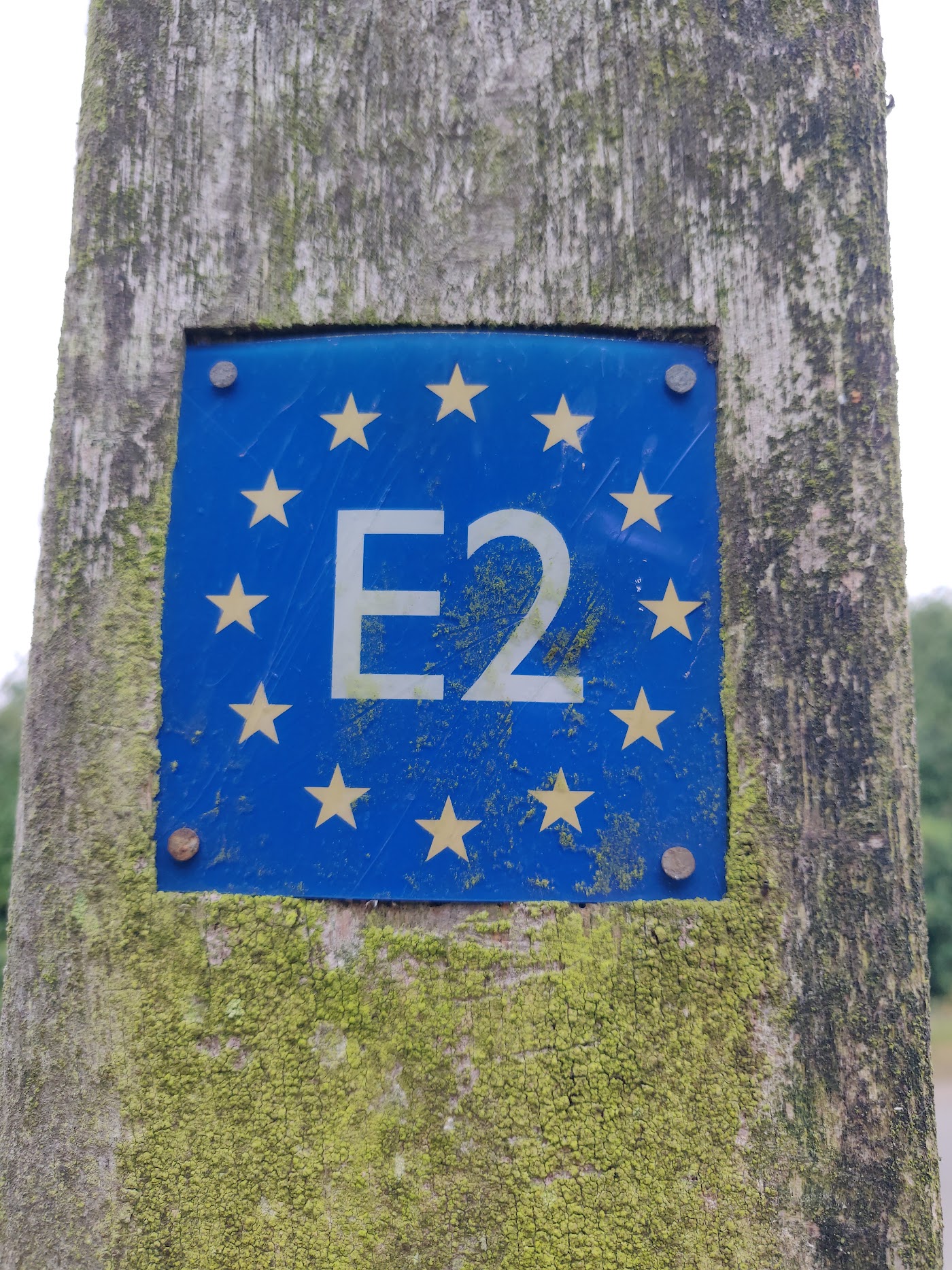
Somewhere along the top I passed a waymark I remembered from the walk to Dover: the little blue E2 badge. The path under my boots runs, in theory, all the way to the Mediterranean; it even shares a stretch with the Tour du Mont Blanc, which I walked years ago and have never quite stopped going on about. I was only going as far as Folkestone.
By Tolsford Hill I’d found a rhythm. The BT tower there is the highest thing for miles, a great grey finger of concrete you can see coming for an hour, and under it my path fell in with another - the Saxon Shore Way, which traces the old Roman coastline, from back when the sea came in far enough to leave Thanet an island and Romney Marsh open water. Two thousand years of the tide quietly backing off the land, and here were two footpaths agreeing to share a hedge over it. I felt good. Really good, in fact: strong and unhurried, eating up the miles, quietly pleased with myself and this whole solo-walking business.
That lasted until a man went past me as though I were a lamp post. A cheerful Nepalese chap, he chatted for a moment and mentioned, in passing, that he was sixty, just retired, and - I could have guessed - a former Gurkha. Then he was gone up the hill, and I was left reconsidering my earlier smugness. Nothing puts a smug morning back in its box quite like being left for dust by a man twenty years your senior.
The sky stayed grey the whole way, that flat Kentish overcast, but it never rained and I didn’t much care. After a year and a bit of lockdowns and the walls of the house, being out on real hills with real distance in front of me was the entire point. Grey was fine. Grey was wonderful.
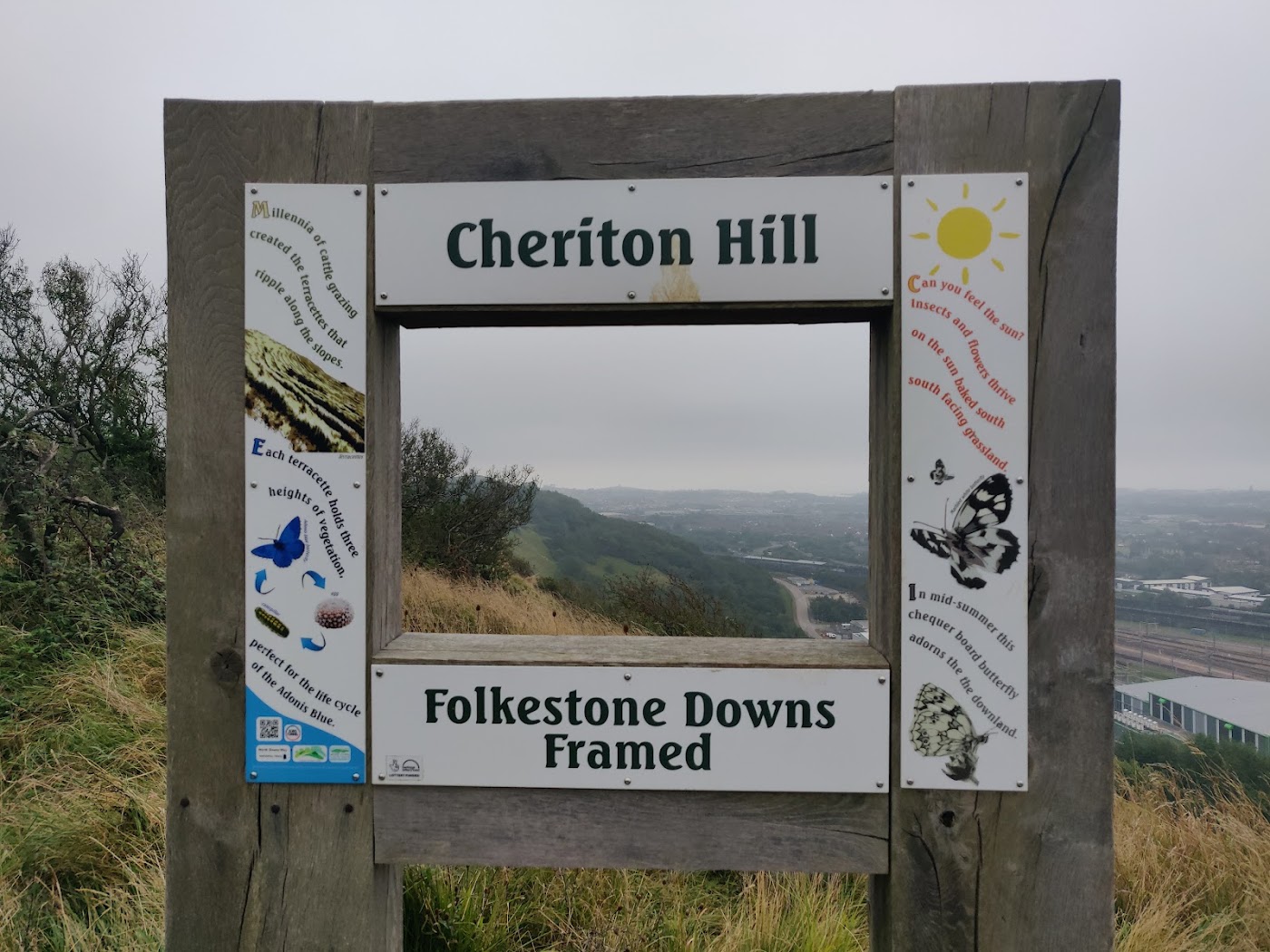
The last few miles tip down off the downs, and Folkestone gathers itself below you: the town, the harbour, the sea gone flat and pale to the horizon. I stayed high above the Channel Tunnel and came out onto Caesar’s Camp, a great tangle of banks and ditches that, for all the Roman name, is really a Norman ringwork castle - the most complete one in the south-east, apparently, though from a footpath it looks mostly like a very ambitious set of molehills. From up there the whole coast opens out. Then I dropped down through the park to Nicole and the car, and the very welcome prospect of not having to walk back.
Eighteen miles, the furthest I’ve ever walked in one go, and not a single pub to break it up. The Merrells from the early walks are long gone; these are the Moab 2s, and they did the job without a word of complaint. The legs are tired in the good way.
So I have my answer. I can do a long day on my own, and I want more of them - somewhere bigger and wilder, several strung together. The Gurkha can come too, as long as he promises to stay behind me.
The walk
| Distance | 29.1 km (18.1 miles) |
| Ascent | 642 m (2,107 ft) |
| Moving time | 6h 07m |
| Route | Wye -> Devil’s Kneading Trough -> Tolsford Hill -> Caesar’s Camp, Folkestone |
| Part of | North Downs Way (Section 14) · E2 European path |
| Terrain | Chalk escarpment, high open downs, farmland, coastal descent |
| Of note | My longest walk in one go; out-paced by a friendly retired Gurkha |